


Maybe you are at an organization preparing for the 2026 midterms. You’re likely hearing a lot from your staff, residents and stakeholders about AI and how it can be used to spike election engagement by manipulating people.
I cover AI from time to time in OIGO and often in my AI and Public Media Futures newsletter. I’m regularly asked about spotting misinformation and how to educate Latino audiences, who are often the targets.
With Hispanic Heritage Month here, serving our communities in this delicate time before elections, to me, is one of the best things you can do. Here’s how you can help by stepping up against AI disinformation.
Where to start
Whether you’re a reporter, a digital editor or anywhere near public media, you may have been queried about the veracity of a social media image. Verification of images and video is the battleground right now. There are a few ways to assist our communities in spotting AI disinformation around immigration narratives. On the run-up to midterms, I always suggest this grounding.
Most questions can be answered when you investigate the claim implicit to the image. As you’re looking into claims posted on social media, among other places, I encourage you to think about three questions first:
Is a video/photograph authentic?
Is it actually from where and when someone claims?
Does it depict what someone says it does?
As you’re trying to sort this out, I tend to see this as less a “how to detect AI” situation. Really, it’s “can we establish that this is, in fact, who, what, where, when and how the image itself is related to its placement?”
Don’t get me wrong: AI is getting more and more sophisticated, and thus harder to detect. Yet increasingly the problem is the real photograph paired with a false location, date or misleading claim. AI is but one danger as the midterms approach.
Manipulating context
There are plenty of social media grifters and people stoking anger and racism for attention and profit. However, not everyone is a bad actor. People regularly reshare something they read about elsewhere. They don’t verify it like a public media organization would. Sadly, this is often how you discover a genuine photograph and a completely false story attached to it.
See what I mean? Context manipulation is even more pervasive than AI. It can often create these common scenarios:
Real photograph, wrong location. For instance, a photograph of immigrants at the Texas-Mexico border, but the photo is labeled as being taken in San Diego.
Real photograph, wrong date. Such as a 2018 border photograph recirculated during the 2026 election.
Real photograph, false description. For example, a photograph of people being processed by Border Patrol, but described as “ICE rounding up families.”
A reverse-image search can potentially solve these issues more than an AI detector. This is especially useful for immigration misinformation because so many old photographs get recirculated as something that supposedly happened this week. Google Lens is awesome at determining when an image or similar image first appeared; where it has appeared previously; how other sites have described it; whether fact-checkers have already investigated it; and whether metadata indicates AI generation or enhancement. Google’s current tools specifically support contextual investigation, free.
For immigration stories, your newsroom should also consider building its own list of experts who can independently confirm or challenge what is circulating. I seek out local reporting, court documents, police or sheriff statements, statements from the organization allegedly involved and credible eyewitness accounts to back it up. I also strongly encourage you to follow Spanish-language reporting and create relationships with local organizations who work in Spanish and can help you help the community.
Immigration in the age of AI
Now, let’s talk AI images.
The cases we worry about most are the manipulated or false photos, like the AI-generated photograph here.
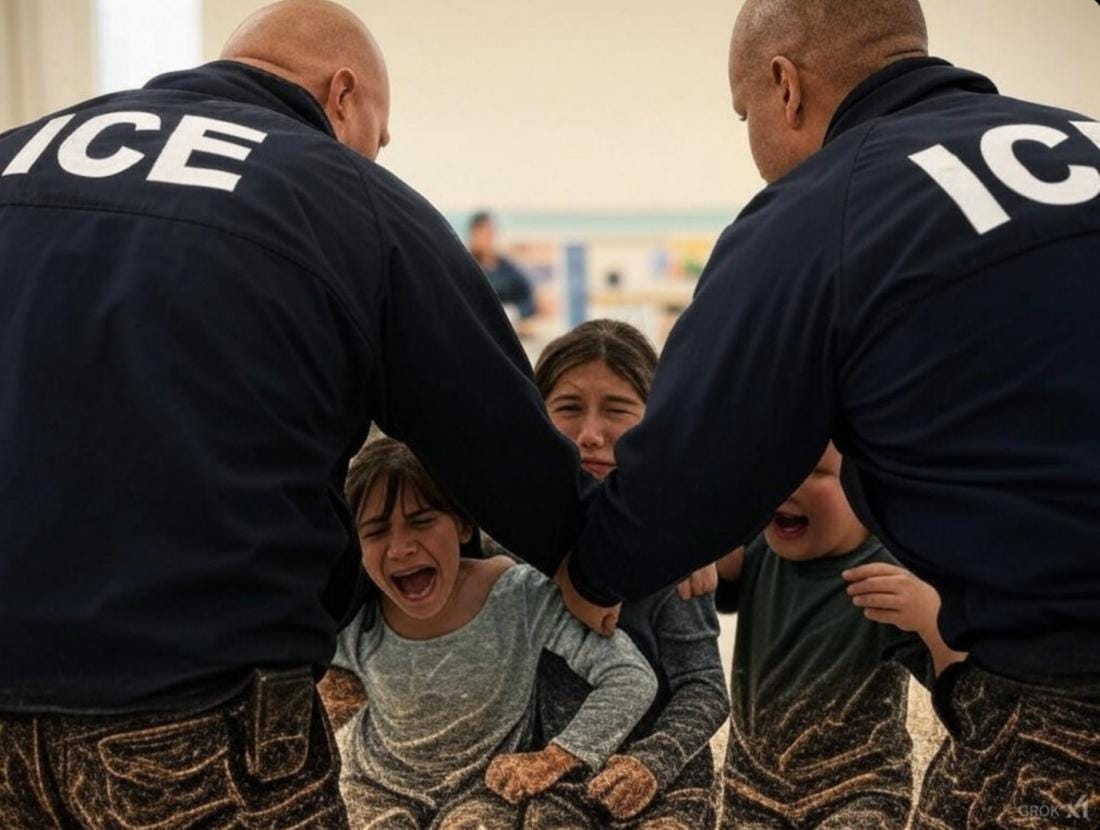
The first layer of AI detection is a keen eye. Look at the children’s hands. See the one in the middle? The distance between the face to the shoulder looks off. Notice how weird the bottom of the photo looks, with off-color wrinkles and the pocket of the officer on the left. When reviewing photos and video, scrutinize images for obvious anomalies. Carefully scan hands, fingers, teeth and ears; signs and text; shadows and reflections; repeated faces or people; unnatural edges; impossible architecture; inconsistent lighting; or distorted uniforms, badges or logos.
Still, AI imagery has improved too much for visual inspection to be reliable on its own. Other tools include provenance, reverse searching and AI detector.
What is provenance? It’s a how we establish a file’s history. Something called Content Credentials can record information about an image’s provenance, including whether it was created or edited using particular tools. Google has been incorporating this information into its image-search ecosystem and claims its “About this image” feature can surface information when available.
Some other resources worth looking at include InVID-WeVerify, which offers tools for video, including contextual analysis and verification of content circulating on social platforms; and Hive, which does specific AI-image and deepfake classification. There are also many commercial-grade AI detection resources, but they could be out of budget for most public media organizations.
Just because an AI detector says an image is fake does not mean that it is. But if you can’t verify facts about a video or photo, it looks strange to the careful eye and an AI detector flags it, there’s a problem. For the midterms, a standard of “verified,” “not verified” and “false” should suffice, rather than forcing journalists into a binary real/fake decision. That gives editors considerably more room to accurately describe what you know, and what you don’t.
Your best defense is preparation
If you’re just now starting, training everyone on Google Lens, Fact Check Explorer and InVID-WeVerify is a great launch point. There’s a lot of online training available. If you have resources, you can also buy Hive credits for select situations where an AI detector would help. If you have more money, are doing AI verification at scale, or you feel like other resources aren’t working, commercial verification platforms are good.
But your secret weapon is probably flexing your journalistic muscle. Create a short list of trusted local sources. Ask them when you have verify immigration-related events quickly.
The larger strategic point is that the best defense against AI-generated misinformation is focus. However, you don’t need every reporter to become an AI pro. You just need journalists to become disciplined about provenance, corroboration and context. 🟢
Cafecito: stories to discuss ☕
Collaborative wins. Connecticut Public’s partnership with El Nuevo Dia recently scored an award for Puerto Rican community reporting. 🥇
Spanish content via AI. An AI broadcast tool is now offering Spanish-language weather reports as well as voiced weather forecasts, using ElevenLabs’ synthetic voice platform, to stations. ☁️ Radio World has the story.
Felicidades. Celeste Guajardo joins KERA in Dallas. 🙌
Understanding audiences. The Local Media Association’s podcast brings out a Pew Research Center expert to delve into its latest study on media consumption habits, with attention to younger audiences. 💻
To watch. A new UCLA study tracks emerging political differences between Latine voters along gender lines. ♀️
El radar: try this 📡
See how local businesses are supporting each other during Hispanic Heritage Month. This is the backstory to a KQED piece on a new business spotlighting area artisans. 💯
Explore how families are preserving Spanish. WTTW published a story on the decline in Spanish amid assimilation, and how parents are ensuring kids are learning the language. 🧒
Look at Latino heritage streets. KJZZ has the tale of a local street of significance to the community, and efforts to protect it. 🚦
Examine faith during Hispanic Heritage Month. WXYZ talks with residents about their Catholic faith brings families together. ⛪︎
Ask how identity shifts over generations. I have written about how matters like intermarriage and tenure in the U.S. can change what we often associate as hallmarks of Latinidad. 🤔 Now, a new Pew study notes how those identifying as Hispanic declines over years. This may be worth discussing locally.
The next OIGO arrives Oct. 2. OIGO reaches its five-year anniversary next edition, and I have many reflections on the past and the future of this newsletter. I hope you will read on.
I’ll be speaking on AI and journalism at the next Maynard Institute Propel training next month. 🤖 It’s free for California journalists.
In November, I’ll be keynoting the Rocky Mountain Community Radio regional conference, as well as doing some other sessions. 💌 I hope to see nearby friends there.
🥤 You can buy me a coffee if you’d like to support the newsletter.