


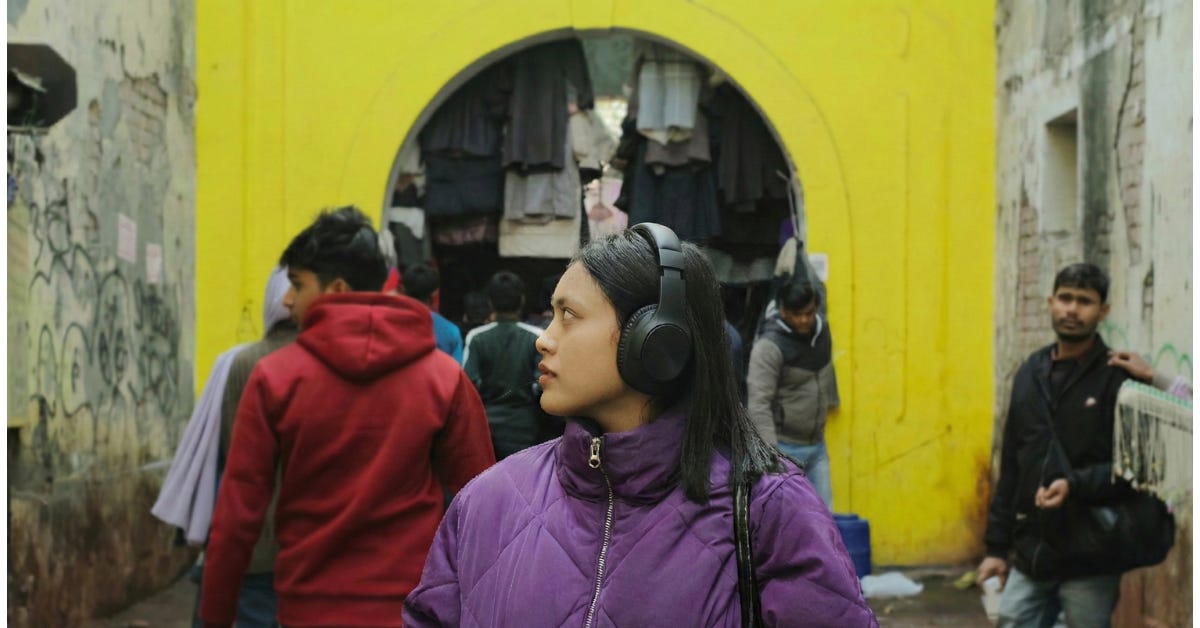
A new national report from iHeartMedia and Collage Group should be on your reading list.
For public media organizations that have long discussed reaching new audiences, an increasing amount of data makes clear that the audiences in question are not emerging someday. They are already here, influential and shaping American culture in real time.
Titled New American Consumer: Bicultural Latinos, the study focuses on Latinos who identify as equally American and Hispanic. The study notes this is a population that now represents nearly 40 percent of all U.S. Latinos. The notion of biculturalism is thus is a cultural, economic and strategic driver to watch.
Takeaways 📝
Identity: The first major takeaway is that bicultural Latinos are not navigating between two identities as many narratives assume. Instead, the research indicates respondents feel they are creating a new one.
About two thirds say they feel equally Hispanic and American, and an overwhelming majority report growing pride in their heritage, with 78 percent saying they feel more connected to it than they did just a year ago.
This is not assimilation in the traditional sense, nor is it preservation of a static past. It is active cultural production.
Spanish: Language, meanwhile, emerges as far more nuanced than conventional wisdom suggests.
Nearly 90 percent of bicultural Latinos consume audio content in English, yet one in three prefers Spanish for music or radio. Many want sponsor language to match the language of the content they are consuming, while a substantial portion prefers English regardless.
Public media has sometimes treated language as a proxy for identity. The research argues that such an approach is insufficient. Bilingual or English dominant programming can still fail if it does not reflect cultural realities, while Spanish language content can resonate deeply when it captures shared experiences rather than relying on surface markers.
Money: The economic dimension is equally striking. Latino purchasing power has reached $4.1 trillion and is growing more than twice as fast as that of non Latinos. If a public media organization is navigating underwriting challenges and long term sustainability questions, this is more than an interesting statistic. It signals where future membership, philanthropy and sponsorship potential will increasingly reside.
Radio: Audio, encouragingly, remains central. Broadcast radio reaches 90 percent of Latino adults monthly, and bicultural Latino listening habits span both English and Spanish content. Many listen with family members, share recommendations and treat audio as a communal experience rather than an individual one. Music listening is nearly universal, podcast engagement is strong and live audio events like sports also play a significant role.
For public radio organizations concerned about aging audiences, this should be a moment of cautious optimism. Audio is not fading in Latino communities. It is evolving as a cultural ritual that connects generations. The opportunity lies in programming that acknowledges that shared listening dynamic rather than assuming solitary consumption.
Assessment 📋
Trust is available, but not automatic. It must be earned through visible commitment.
Respondents’ perspectives should challenge lingering assumptions about audience segmentation. Too often, institutions treat Latino audiences as either Spanish dominant or English dominant, immigrant or second generation, niche or general market. Bicultural audiences do not fit those boxes. They expect content that reflects their lived experience as fully American and fully rooted in heritage at the same time. That means coverage, storytelling and staffing strategies that move toward cultural fluency.
Cultural competence is a core strategy for future relevance. This includes hiring practices, source diversity, community partnerships, programming decisions and marketing approaches. It also requires recognizing that bicultural audiences are co-creators of the cultural landscape.
One of the most powerful lines in the report suggests that culture is the strategy, while language is the tactic. Public media institutions would benefit from internalizing that distinction. Translation alone will not build loyalty. Representation requires authority to build trust. Our hope remains in sustained engagement. 🟢

Cafecito: stories to discuss ☕
New playbook. The Covering Immigration tool offers a range of resources and intel for public media organizations looking to up their immigration coverage game. ✍️
Fresh support. The Latino Media Consortium has launched the Assessment & Capacity Building Program and Dashboard, a new initiative developed in partnership with New Media Venture’s Latine Voices for Democracy Accelerator, to expand operational support for independent Latino-serving media across the United States. 💻 Details.
Detention. A coalition of groups are calling for the release of journalist Estefany Rodriguez from ICE custody. ⛓️ Free Press has more.
Radio to TikTok. iHeart has announced Venezuelan artist Lele Pons is among the personalities to lead its new TikTok Radio channel, where creators will share and discuss music, trends and more, starting at SXSW. 📱 RadioInk has more.
News creator economies. Poynter sits down with former journalist Chris Vazquez, who has transitioned to the news creator space, about his approach to this work. 📌
New network. Comercio TV, a new Spanish-language financial news channel, has launched on cable and streaming networks. 📺 Cablefax offers the story.

El radar: try this 📡
Check the community pulse. WFYI covered a local forum on bipartisan solutions to issues in Indiana. 🏢 Immigration was front of mind.
See who is connecting Latinx residents to winter sports. New Hampshire Public Radio has a fresh piece about regional groups seeking to encourage involvement in skiing and other winter athletics by Hispanic residents. 🎿
Share family stories. Avanza has introduced Latino Legacy, a new series that presents “the stories, history and cultural contributions of Latinos in Utah and beyond.” 🔊
Investigate crackdowns aimed at criticism. The Denton Record-Chronicle, via KERA, takes a deep dive into allegations a local art exhibit on a university campus was closed due to criticism of ICE. 💡 I’d be surprised if similar contentions were not happening elsewhere.
Follow up on local Venezuelan communities. In the period since the arrest of Nicolas Maduro, Venezuelans in the United States are considering a range of needs. 💭 KQED highlights its local Venezuelan residents to talk about culture and the news cycle affecting their homeland.
The next OIGO arrives Mar. 27. Next OIGO, it will be an honor to present my KQED colleague, Blanca Torres. She’s a fantastic journalist and authors K Onda KQED, a station newsletter aimed at Latine audiences. You’re certain to learn a lot from her.
My interview after receiving the Public Media for All award is live here.
I am honored to be leading AI and also broadcast training at the Maynard Institute’s Propel Initiative Regional Training Series with California Polytechnic State University on April 24-25. Registration is open. Sign up here.
🫖 You can buy me a coffee if you’d like to support the newsletter.