


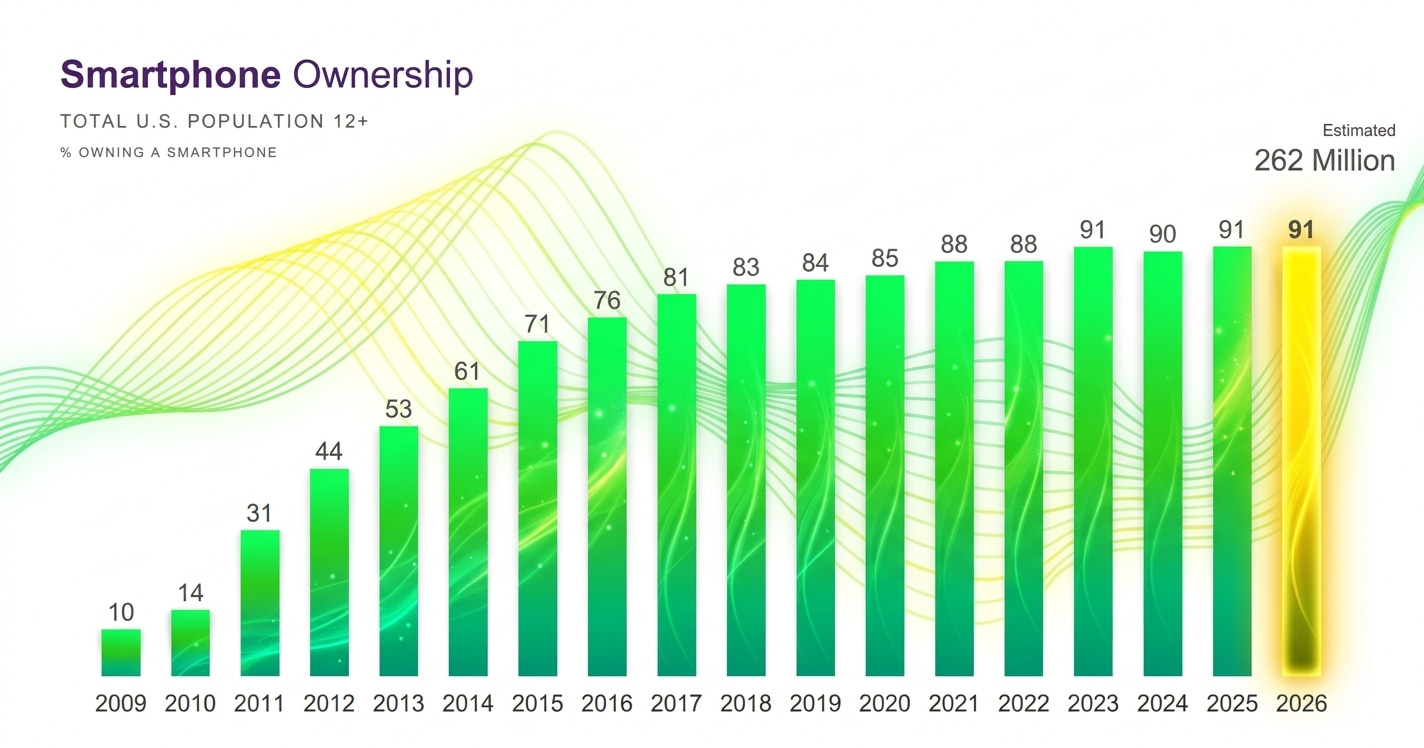
The Infinite Dial 2026 study from Edison Research is one of those annual milestones for public media. Leaders pore over it, trying to understand how listening is trending. This OIGO, I want to take a look at the new Infinite Dial in the scope of Latine audiences.
The insights in this summary are, of course, derived from the Infinite Dial 2026. If you are not as familiar, it is a study conducted by Edison Research, which has U.S. and international editions. This particular U.S. study surveyed 2,050 people aged 12 and older using a combination of probability-based and non-probability online sampling.
To provide a specific lens of diverse listeners for the benefit of public media leaders, I took this core data and cross-referenced it with 2025-2026 Nielsen Audio Today reports and Pew Research Center demographic profiles of U.S. Hispanics. These external sources provided the necessary context on Latinx age distribution (for reference, the median age of Latinos is just under 30). I also language fluidity (Spanglish trust signals) and how streaming over-indexes to overlay onto the broader Infinite Dial trends.
The nutgraf?
The data suggests that digital audio has shifted from a secondary marketing consideration to a fundamental part of the modern daily routine. For public media leaders, particularly those serving emerging Hispanic audiences, these trends provide a clear roadmap: the future is mobile-first, video-integrated and finding ways to utilize artificial intelligence.
Public media outreach to diverse audiences 🔋
Let’s look at the 2026 data. The item many are talking about is how online audio consumption has reached unprecedented heights. How big? Currently, 81 percent of Americans age 12 and older have listened to online audio in the last month. That seems pretty incredible, though it splinters the more you look. YouTube, Spotify/music streaming and smart speakers are among those platforms commanding the most attention.
Perhaps more significant for public media is the surge among older listeners. Monthly online audio listening for those aged 55 and older jumped from 52 percent to 70 percent in just two years. It’s by no means heavy listening on the level of traditional media, but this is a notable figure.
How does this data compare with what we know about Hispanic audiences?
Well, this trend is even more pronounced. External demographic data from 2026 suggests that Hispanic viewers spend 55.8 percent of their total TV time streaming, compared to 46 percent for the total U.S. population. When combined with the Infinite Dial’s findings that monthly podcast consumption has hit an all-time high, it is clear that “digital” is becoming a default.
Other takeaways 🎛️
Based on the 2026 Infinite Dial study and current Hispanic demographic trends, three key issues also emerge:
YouTube as an alternate FM. The Infinite Dial study cast with Nielsen findings confirms that YouTube defies simple categorization. While 91 percent of Americans have used the platform, a staggering 78 percent use it weekly. For Latine audiences, YouTube is the top platform for monthly podcast listeners.
YouTube though, you say? Public media leaders should note that the boundary between “listening” and “watching” has dissolved. 57 percent of Americans now report they have both listened to and watched a podcast. As you are seeing from CNN, video and audio are expanding the audience together rather than competing; a viewer gets the podcast vibe, and the listener gets a sound from it all. Thus, a “video-optional” strategy for news and talk programming is no longer sufficient.
To reach Hispanic Gen Z and Millennial audiences, public media should treat YouTube as a primary delivery hub.
Radio still strong, but pick a horse on social. While broadcast radio remains a dominant reach vehicle for Latine adults, touching about 93 percent of the demographic monthly, the Infinite Dial points out that social media platforms are highly fragmented. TikTok is the #1 platform for those aged 12-34. Meanwhile, Facebook remains the leader for those 55 and older.
An opportunity with platforms? Demographic data shows that using Spanish or Spanglish functions as a credibility cue. Public media leaders could use personalities who can teach and guide listeners. Such might resonate with a community that views hosts as extensions of their own community.
AI’s emergence. One of the most surprising 2026 data points is the speed of AI adoption. 93 percent of Americans are familiar with at least one generative AI brand, and 57 percent use at least one. This adoption has moved faster than any technology previously measured by the Infinite Dial.
AI users are significantly more engaged with media than non-users; 87 percent of AI users listened to online audio in the last week. For public media, this presents an opportunity to remove technical friction. Whether through smart speaker integrations or AI-driven translation for bilingual audiences, early adoption of these tools can accelerate engagement with high-value digital listeners.
Our today is mobile 🔔
The throughline connecting all of these data points is deceptively simple: Hispanic audience trends are going to help public media to be ahead of all trends.
What is interesting is that the communities that have historically been underserved by legacy media are now, by the numbers, among its most digitally engaged and platform-fluent users. That is not irony — it is an invitation. Examples of this signal are everywhere. The convergence of mobile-first consumption habits, YouTube’s redefinition of what “listening” even means, and AI’s accelerating hold on engagement creates a window for public media to act with fresh ideas and action. Public media leaders who internalize these trends as structural rather than cyclical will be better positioned to build the kind of trust that algorithms cannot manufacture: the sense that a media institution genuinely reflects the world its audience actually inhabits.
The data gives us the map. The harder work is institutional will. 🟢

Cafecito: stories to discuss ☕
Released. Nashville-based journalist Estefany Rodríguez is speaking up after her release from ICE custody. 👀 MS NOW interviewed her.
Spanish-language news influencer. The New Yorker profiles Carlos Eduardo Espina, who has built a massive TikTok following with news and analysis in Spanish. 🗣️
Grants. The Latino Community Foundation has announced $250,000 in grants for six organizations seeking to protect communities amid ICE enforcement. 🎇 Business Wire has the press release.
Tejano election. One of the more interesting races happening right now is a South Texas Congressional seat, which has seen Tejano music superstar Bobby Pulido running for political office for the first time. 🏜️ A shot at him by a rival candidate (“this election isn’t about who you want performing at your niece’s quinceañera”) has fueled his recent performances at quinceañeras. The Texas Tribune has more.
Conecta Arizona turns six. KJZZ has a great story on the nonprofit’s work to serve Spanish-language audiences. 🤲

El radar: try this 📡
Track Chavez fallout. Impressive local coverage by Minnesota Public Radio is one of many stories to take inspiration from, as far as telling local perspectives about the issues raised in the scandal. ✍️
Watch how states are treating college admissions for immigrants. The Kentucky Lantern is investigating how civil rights groups are challenging the state’s approaches around tuition. 🏘️ As how immigrants are treated rises as an election issue, your audience might be interested in how the administration is arguing such cases.
Ask how immigration enforcement is reshaping electoral races. WAMU offers a look at a heavily Latine district in the area and how the White House’s actions are shifting voter attitudes. 🤖 One to watch this fall.
Follow student protests against cuts. KCUR features interviews with students who disagree with university decisions to cut services for diverse campus constituencies. 💢 As the DEI rollback continues, this will be a local story for many organizations.
Follow moving trends. Documented has a thoughtful piece on how housing costs in New York City are prompting more Latinos to move to the suburbs. 🚉 Affordability is a major election issue, and this will be a story in your community.

The next OIGO arrives April 24. Pew Research has issued a report on the rise of religious broadcasters, a sector of noncommercial broadcasting public media does not talk often about. ⛪ I will explore the data and tell you some things you should know as it relates to diverse audience engagement and ways you can innovate.
You can buy me a coffee if you’d like to support the newsletter.