



It’s easy to tune out the conversation around multilingual AI. It’s not so easy when you look at it as a parallel to English-language institutional media’s relationship with Latinos.
Spanish, for me in public media, has been the plaintive requests to “translate something,” the one-off social media post or tests with no investment. In truth, Spanish has been the perpetually underestimated medium that many in English-language media treated as a derivative of English rather than an expression unto itself.
If you’ve noticed this too, the journey of Large Language Models (LLMs) around Spanish may feel familiar.
Online, there are no shortage of examples of clumsy auto-translation and chatbots that flattened the tonal architecture of Spanish into English mush. This too may feel painfully familiar: this language, and by extension its speakers, were an afterthought in the rooms where work lives.
That history is why the technical leaps of 2025 and 2026 feel like more than a product update to me. They represent, however incompletely, a belated acknowledgment that the Spanish-speaking world was never a secondary market. It was always a primary one that simply lacked sufficient advocates.
Thus today the era of AI acting as a clumsy Spanish translator is gone.
The evolution of the engines behind tools like ChatGPT has reached a milestone. These systems no longer just translate and compose content in Spanish; they are better presenting its cultural nuances and regional dialects. For you seeking to meet the specific requirements of professional journalism, AI is as good as it’s ever been.
I’ve written about AI and its potential for inclusive content in OIGO previously. And if AI isn’t your thing, cool. But if you’re like Avanza and other organizations trying to figure out how to better serve your community, you may be intrigued by how these technologies can help you.
How things have improved 🔄
But first, some remarks of how AI has made strides, and why.
I remember feeling some vertigo while watching an early LLM process a Spanish transcript and return something that resembled a middle-school paper. The model had not misunderstood the words so much as it had misunderstood the intention that no amount of vocabulary training could recover. It felt as if the words were converted without Spanish speakers as the intended readers.
So, it’s important to say how AI has strengthened its Spanish. Three major technical shifts have leveled the playing field for non-English content:
“Tokenization.” To an AI, words are broken down into small pieces called tokens. In 2024, Spanish text required more “tokens” than English to express the same idea, making it slower and more expensive to process. Fast forward to 2026, where new advances have made the process almost equal.
For a public media organization, this means running a Spanish-language chatbot or automated transcription service can now be fast and cost-effective as an English one.
RAG. Previously, an AI relied only on its training data). Now, these models use Retrieval-Augmented Generation, or RAG, to “fact-check” themselves against external, trusted sources before they give you an answer. RAG strides have drastically reduced hallucinations in Spanish, ensuring that a summary of a local city council meeting in Mexico is based on actual records rather than the AI’s “best guess.”
Regional nuance improvements. Earlier models often defaulted to a generic Spanish that felt “off” to native speakers. If AI companies excel at anything, it is listening to the customer base and taking credibility seriously.
Now, current models have better and more specific training to get Spanish right. You can give a specific command like, ”Write this news lead for an audience in Argentine Spanish,” and the AI model can successfully incorporate local slang and grammatical preferences without reverting to English.
Top LLMs compared 🧮
Let’s go head to head.
Google Gemini and its 3.1 Pro model is arguably the most versatile tool for multimodal media. How so? Well, it can “read” and “understand” more than just text. Its model is great at not just transcribing audio, but detecting nuance. Thus, a raw audio file of a Spanish-language interview can be returned by Gemini with an accurate summary, identifying not just the words but the tone and cultural subtext.
Gemini’s appeal to most is that it is integrated into Google Workspace, Additionally, Gemini is highly effective at administrative tasks, such as drafting using the appropriate level of professional Spanish (usted) versus casual social media copy (tú). This sort of detection is not required, but it’s helpful.
ChatGPT is the tool your mom knows. And, on the whole, Spanish conversion and translation is very good. In my own experiments, When I first began testing ChatGPT’s code-switching capabilities systematically, I was less interested in whether it could manage Spanglish than in whether it understood why Spanglish exists. Can it move fluidly between languages within a single sentence? The code-switching that characterizes bicultural Latino speech is a sophisticated rhetorical practice. If you submit a transcript that mixes English and Spanish, the model maintains the context without getting confused.
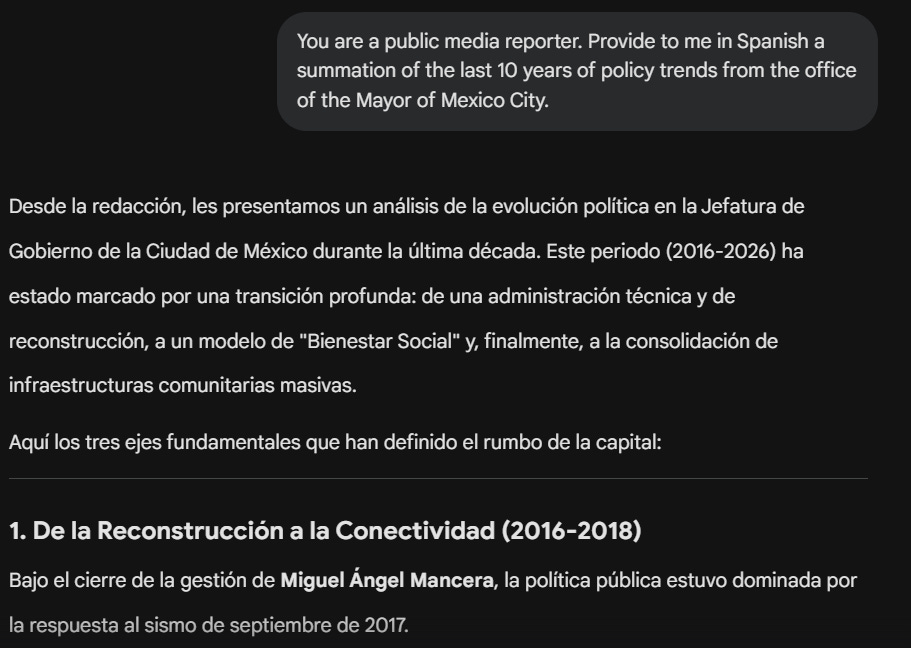
For editors, ChatGPT’s Canvas feature is essentially a collaborative digital workspace. You can ask the AI to rewrite a paragraph in a more “neutral” Spanish or to punch up the headline for a specific regional audience (e.g., adjusting for a Caribbean Spanish or a Southern Cone readership) in real-time.
Claude is often the preferred choice for analysis, and is seen by many I talk to as a better writer. In addition, Claude uses a reasoning process that makes it less likely to make up facts that sound plausible, but are false.
The consequences of hallucination in Spanish-language journalism, for the communities I have spent my career aspiring to serve, carry an additional dimension that "accuracy" does not fully capture. Latine communities have navigated, across generations, being misinformed about ourselves. When an AI model generates a plausible but false summary in a language that a community depends on to understand its own reality, it is perpetuating a historical pattern of unreliability that these audiences have every rational reason to expect. It’s concerning, and thus makes such protections important.
With Spanish, Claude tends to avoid robotic as well as overly flowery language that models were once quite notorious for producing. Per the writing part, because you can train to a certain style you choose, Claude is ideal for summarizing dense policy documents, among other use cases.
Two other models were a look are Perplexity and Microsoft Copilot.
Perplexity is a “research-first” engine. This platform rose to prominence because it did deep research as well as searches of the live web. For a journalist, this is invaluable for tracking how a story is being covered in real-time across Latin America or Spain, citing specific sources like El País or CNN en Español.
Copilot is as if ChatGPT were tuned to work inside Microsoft Office. Your use and results may vary. However, I understand Copilot may be good if you are transforming a Spanish-language memo into a slide deck or a spreadsheet, for instance.
What to use 🔢
The hope for many in the tech and journalism space is that AI can be a cultural collaborator. Now, these tools are nearing the precision required to serve the Spanish-speaking public with the same depth as any English-speaking audience.
The choice of tool depends entirely on where you sit in your organization and your role’s relationship to Spanish-language engagement.
For Producers: Gemini is good for its ability to handle diverse media formats (audio/video).
For Editors and Copywriters: Claude or ChatGPT offer creative flexibility in their Spanish prose.
For Researchers and Fact-Checkers: Perplexity provides impressive levels of reliability and sourcing.
For you with concerns about AI, I do not suggest that the tools here operate with good or bad intentions. I suggest, rather, that intention is insufficient as a standard.
The question for English-language media organizations evaluating these tools is not simply whether an LLM can now navigate Mexican slang or maintain the grammatical architecture of a Salvadoran interview transcript. I seek to see how the communities whose linguistic and cultural knowledge trained these models can genuinely benefit. Can public media help with new investments of time and resources that benefit all?
I remain provisionally optimistic, but I have been in public media long enough to know that optimism, without accountability, is its own kind of naïveté. 🟢

Cafecito: stories to discuss ☕
AZ next week. The annual Hispanic Radio Conference, which primarily focuses on commercial radio, happens in Phoenix. 🎚️ New demographic data and tracking of financial shifts are key themes.
Debate evolving. Austin is one of the more prominent places divided about changing a street named after Cesar Chavez. 🛣️ KUT is on the story.
Inspo. Georgia outlet Esta es la Cosa has created a Spanish-language Kit Acción Inmigrante to inform residents where to go for essential services like housing as well as mental health resources. 📄
Stat to watch locally. The number of Gen Z Latine voters has jumped compared to Millennials, according to a Georgia study. Here come midterms. ✔️
Related: Latino Trump voter support has declined, Pew Research Center findings show, though 66 percent of this group still back the president. 📣
Creator threats. I noted last OIGO my own reservations about the influencer journalism model, and the Guardian has a new piece on this subject. TLDR: “What we are witnessing is the wholesale shift from one established information ecosystem to another.”

El radar: try this 📡
Provide a local Latine neighborhood guide. WHYY just offered one for a burgeoning new community in its region. 🏢
Highlight healthcare needs. WLRN spotlighted a new report by UnidosUS about the health and wellness needs of Latinx voters. 🥗 Well worth a localized look.
Spark conversations about men and violence. Texas Public Radio covered a San Antonio nonprofit that is seeking to engage Latino men more on issues of intimate partner violence. 💬 An important dialogue.
Foster a love of wine. Alcohol consumption is down, and businesses are seeking ways to connect with consumers. 🍷 Northern California Public Media features efforts to foster a love of wine among Hispanics.
Note housing insecurity. WBEZ tracked trends related to Latine homelessness. 🎺 People living temporarily with friends and family because they had nowhere to go was among the prevalent trends.

The next OIGO arrives June 12. I’ll be in Seattle next week to connect with colleagues at KUOW. If you’re in the area, reach out and let’s catch up.
Stay tuned to the Latino Media Collaborative’s website and social media for details on a session I’ll be doing for the group in June around AI tools for nonprofit news leaders. 💻
In October, OIGO turns five. For a short time, those who want to support can pick up a 20 percent discount on an annual pledge. Get it here, and gracias. 🙏
Also, you can buy me a coffee if you’d like to support the newsletter.