


Years ago, I remember hearing a producer refer to listeners as "my audience." The phrase passed without notice. We all use it. But over time, I started wondering what assumptions were hiding inside those two words.
What I realize now is that there is a particular kind of institutional overconfidence embedded in the phrase “my audience.”
It sounds like stewardship, but functions like ownership. And in a media landscape where trust is being redistributed, such a distinction is more than merely philosophical, but existential.
Community media and public media need to reflect on these issues on many fronts. How that shows up in reaching growth audiences, especially Latino and younger generations, needs our urgent attention.
The newest Media Insight Project study offers a simple, but stunning, portrait of a wider media ecosystem in flux. It’s in no small part because how the people who look to media are changing in their expectations and needs.
For organizations that have historically under-served, or simply under-noticed, Latinx communities and newer generations, this is your moment. It’s time for you to lead a conversation in-house about something more foundational than strategy. Let’s talk about how we see relationships.
Latino public media strategy
One of the most important lessons I’ve learned working with Latinx communities is that relationships rarely begin with information. They begin with trust.
That may sound obvious. Yet many media organizations still behave as though trust arrives automatically with the product.
Like Latinidad, the Media Insight Project findings in The Evolving News Landscape: Comparing Media Habits and Trust Between Teens and Adults are instructive precisely because they resist easy comfort.
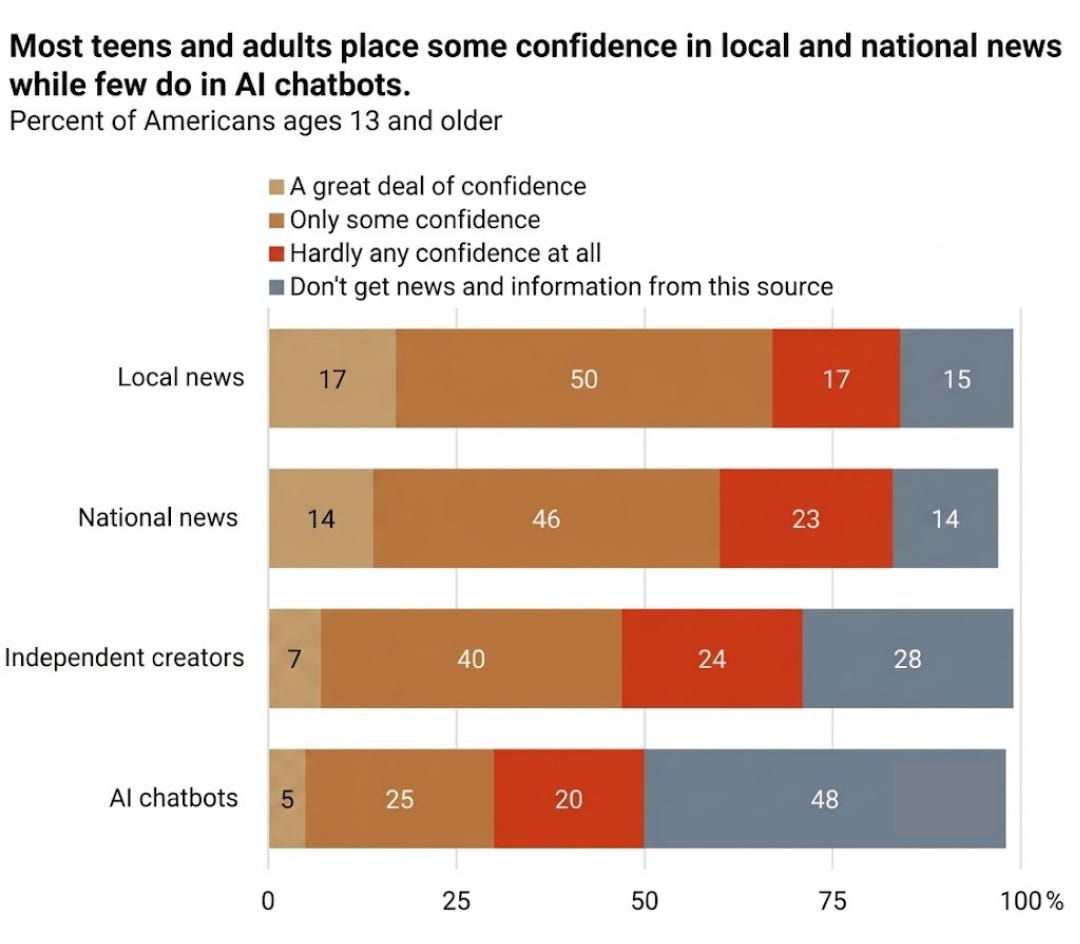
Local news remains the most trusted source across age groups. But look closely at the data: The some/no confidence and don’t-use-this-source make up significant chunks of the respondents. Fewer than half of teens and adults express a great deal of confidence in any news source type. The New York Times reports such agnosticism trickles into politics too. It’s important insight for those who assume once you’ve hooked someone, they’re yours forever.
Nope.
Trust, the study confirms, is not a given. Instead, trust is earned incrementally, renewed constantly, and revoked without ceremony.
Pair this with a recent study by the Center for Integrity in News Reporting and the stakes for public media go up. Not much trust or unfamiliarity with NPR? Uh oh.
Elsewhere, younger Americans, including Hispanic youth who skew younger as a demographic, show similar levels of confidence in both traditional outlets and independent creators. They do not grant institutional journalism and media automatic authority. The door is not closed, but also, it is no longer propped open by default.
Equally significant is the fact that 48 percent of teens (more than any other age group) get local news from local influencers or independent creators. This is massive compared with 23 percent of adults, 65 and older.
Confianza
In Spanish, there’s a word called confianza. It translates to “trust,” but in practice it explains the interpersonal confidence that structures Latino social relationships. It extends to familiarity and reciprocity built over time. It does not transfer automatically to institutions that have not done the relational work.
Hispanics are among the fastest-growing segments in American media. Our story is not a cozy one of assumed politics, cultural narratives and even linguistic hard lines. As my KQED colleague Blanca Torres beautifully put it, Latino culture is broad, and it is American.
Winning organizations will be the ones who see the importance of the people and the relationship.
Too often, engagement has been framed as a capture strategy rather than a consent relationship. Stephanie Kord Miller‘s framing in her post mortem on NPR Digital Services cuts directly to the issue: a listener who tunes in, signs up for a newsletter or makes a membership donation is not transferring ownership of themselves. They are granting permission to be communicated with. That permission belongs to the person who gave it. It travels with the listener, not with the institution.
This matters enormously when we consider how Latinx audiences have been approached by legacy media organizations. At worst, this shows up as the Spanish-language newsletter launched in an election year or a “Latino outreach initiative” that evaporates when the funding does.
These are not trust-building efforts. They are transactions dressed up as relationships. Audiences, particularly those who have spent decades being addressed only when they were numerically convenient, can feel the difference.
A mindset shift can be a difficult idea for membership- and listenership-driven organizations. We celebrate acquisition, retention and loyalty. Those metrics matter. But they can obscure a more important reality: the relationship belongs to the audience member, not the institution.
Listenership is simply ongoing consent.
The institutions that navigate this well will be those that restructure their understanding of audience relationships at a systems level. That means Latine community engagement is an organizational value that shapes hiring, sourcing, story selection and how feedback loops are built and honored.
Trust is a habit
Growing up in Latino communities, I can tell you that confianza wasn’t established because someone introduced themselves once. It was established because they kept showing up. The priest who came by to check on us. The teacher who remembered your family. The neighbor who dropped in after the crisis had passed.
Trust wasn’t a declaration, but a pattern.
Confianza accretes through consistent, low-stakes interactions. Just as importantly, it comes with time. For Latine audiences, consistency has an additional valence. It signals that the coverage is not contingent on a news peg. When communities are present not simply when something goes wrong, but are woven into the fabric of what the organization considers worth knowing, people see that.
Younger audiences are sending a similar signal. They have grown up in a media environment defined by abundance rather than scarcity. They do not assume institutions deserve attention simply because they exist. Every source competes for credibility every day.
For public media, this can feel unsettling. But it is also an opportunity. Trust is no longer inherited.
The Media Insight Project study notes that news fatigue is real and widespread, with most Americans actively managing their exposure. They avoid not just celebrity news and political content, but sources that feel extractive or unreliable. In this environment, the newsrooms that will retain and grow Latinx audiences are not those with the most sophisticated analytics dashboards. They are the ones that show up, in the right language, with genuine consistency, long after a moment of crisis.
Every public media leader should ask a simple question: If our Latine audience disappeared tomorrow, what evidence would they cite that we truly knew them?
Would they point to a sustained relationship? Or a collection of campaigns?
Every interaction is another opportunity to answer the same question: Are you still here?
For public media, the future may depend on how often the answer is yes. 🟢

Cafecito: stories to discuss ☕
New podcast. American Colony, a bilingual podcast series exploring Puerto Rico’s history, launches July 4. The Latino Newsletter is co-producer.
Nonprofit board challenges. Public media has its share of governance, and a new study by the Knight Center notes a disconnect between organizational leaders and boards. 🤔 There are also difficulties with board members understanding their roles.
Afro-Mexican radio. LatAm Journalism Review examines a radio station in the state of Oaxaca that serves the African descended community there. ၊၊||၊
Inspo. City Bureau is changing its content focus to affordability, and its internal team from Editorial to Civic Information. 💡
Related: Nieman Lab highlights how hard news drives subscriptions.
Sparking comunidad. KEXP’s Albina Cabrera has launched a new monthly Noches de Rock en Español in-person music series in Seattle. 💿 She’s among the DJs performing live around the city. The next event is July 3.
Felicidades. A range of Latino news leaders were winners in the Local Media Association 2026 Digital Innovation Awards. 🏆

El radar: try this 📡
Explore DACA downstream effects. KQED featured a morning program conversation on how renewal delays are impacting DACA recipients and raising fears about the future of communities. 👀
Share World Cup vibes. WGBH is among many reflecting community voices about the games. ⚽
Related: Noting World Cup, RadioInk says the experiential industry boom represents a major opportunity for broadcasters.
Offer dimensions to the Hispanic business narrative. Many of us have heard that Latine entrepreneurship is growing. 📈 Marketplace investigates how little venture capital intersects the sector.
See how local small businesses are supporting residents. WLEX has an interesting story about a family firm that started out selling insurance. 🏢 It quickly became one offering a range of services to the area’s immigrant population.

The next OIGO arrives July 17. Voting is open for 2026 NETA conference sessions, but closes Monday. I’ve co-pitched the “More Than A Special” 60-minute session. If you are so inclined, vote here to support our inclusion on the agenda. ☑️
My AI session for the Latino Media Collaborative is June 23. 💻 You can register to attend for free here.
🥤 You can buy me a coffee if you’d like to support the newsletter.